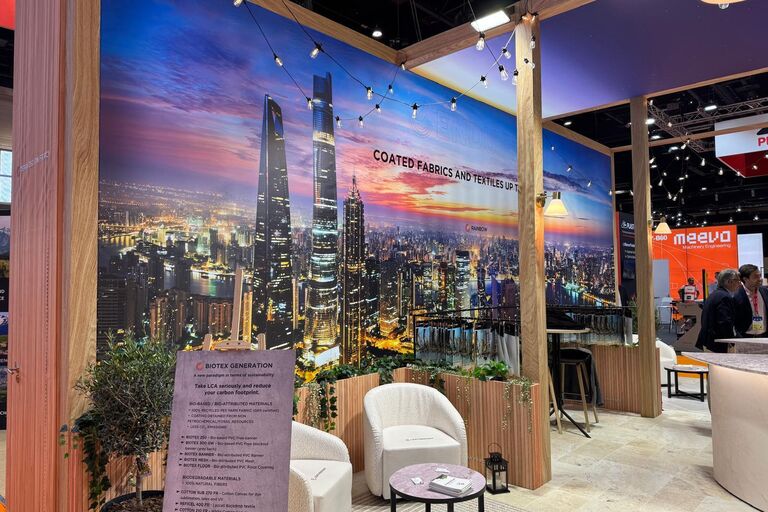
Most last-minute panics trace back to the same problem: the media wasn't chosen for the job it's actually doing. A substrate that looks great in the studio can fall apart completely once it's out in the real world - fading under a full day of direct sunlight, lifting at the edges in the wind, or turning into a soggy mess the moment the weather turns. And at an event or exhibition, where everything is visible and there's nowhere to hide, that's the last thing you need.
This guide is about making those decisions properly, before the event - going through each display element and working out what it actually needs to survive and perform outdoors. It’s important to get all this right at the planning stage, before it’s too late.
Backwalls and large format graphic panels
The backwall is where the brand makes its first impression. It needs to deliver consistent colour, hold its tension without creasing, and look sharp whether it's 2 metres away or 20. This is where fabric graphics have largely taken over from traditional PVC for good reason.
Currently the most popular media in this area, Display Pro Eclipse is a knitted 260gsm textile with a soft finish, crease resistance, and enough stretch to install cleanly into SEG frame systems. It can be wrapped or stapled around framework, which makes it versatile across different stand configurations. Critically, it offers a better white point and smoother print surface - which matters when you're printing high-resolution brand imagery that needs to hold up at close viewing distances.
Designed for front-lit applications, the knitted construction helps diffuse light evenly allowing the surface to handle the kind of colour depth clients expect from a premium display.
The key question with backwall fabric is always the frame system. SEG, tension frame, wrap-and-staple - the substrate needs to suit the installation method. Display Pro Eclipse handles all three, which reduces the risk when a client changes their stand configuration at short notice.
Modular systems and structural wraps
Modular exhibition systems present a specific challenge: the material needs to perform over the full surface of a structure, often with joins, curves, and awkward corners, while delivering complete blockout so the structure itself disappears behind the graphic.
Pro Eclipse 450 is built for exactly this. It is a 450gsm semi-coated banner material with a black reverse that prevents show-through entirely - the structure behind it is irrelevant and completely unseen. The woven base cloth gives it class-leading tear and tensile strength, which matters when the material is under tension across a large structure or being handled by installation teams working quickly on-site.
The matt print surface is optimised for close viewing, which is important when visitors are within arm's reach of the graphic rather than looking up from a distance. EN13501 B s1 d0 fire rated and available up to 5m wide, it covers the range of modular systems in regular use - including tension frame systems for up to a year of deployment.
Roller banners and freestanding displays
Roller banners get treated as the workhorse of the exhibition stand - the last element specified, the first to be value-engineered. But a poor-quality substrate in a pull-up banner creates problems that are visible to everyone on the stand: curl at the edges, inconsistent lay-flat, print that looks slightly off against the premium graphics elsewhere.
PET Greyback 290 is a 290-micron blockout banner made from PET (Polyethylene Terephthalate) with excellent lay-flat properties, a smooth matt surface, a genuinely good white point, and no edge curl – it’s the difference between a roller banner that looks intentional and one that looks like it was printed in a hurry.
Available up to 2.2m wide, it suits the full range of standard banner stand formats. The smooth surface means print consistency is high, which matters when the roller banner is being used alongside larger format graphics from the same campaign.
For single-sided blockout banner applications beyond the standard roller banner format, PET Greyback 290 handles those too.
When sustainability is part of the brief
More clients are arriving with sustainability requirements that go beyond a preference - they are part of the brief. For those conversations, Biotex Banner provides something verifiable rather than aspirational.
Biotex Banner is a 450gsm knife-coated PVC banner material produced using 100% recycled yarn (GRS certified) with a coating derived from wood-based residue from the forestry industry - not petrochemical or fossil resources. It represents a verified 30% reduction in CO₂ emissions compared to a conventional European-made banner material produced at the same facility, with a cradle-to-gate LCA available to document it.
The LCA uses the same production facility, the same methodology, and a functionally equivalent comparison product - which is the kind of rigorous, like-for-like assessment that stands up to scrutiny. EN13501 B s2 d0 fire rated and available up to 5m wide, it is a direct functional substitute for standard banner material at events and activations.
For clients who need to demonstrate environmental credentials rather than simply claim them, the difference between a product with verified LCA data and one with a vague "eco-friendly" label is significant.
Airy dividers and zone separators
From open exhibition stands to fence meshing and building wraps, mesh provides the practical answer: it separates areas visually without creating solid walls that reduce light, wind or restrict sightlines.
Mesh materials let air flow through while still carrying full printed graphics. The perforated nature of mesh does not significantly diminish print impact at normal viewing distances - the image reads clearly while the material itself stays light and open. For stands where the product being exhibited benefits from an airy, uncluttered environment, mesh dividers are the right material.
For clients with sustainability requirements, Biotex Mesh brings the same environmental credentials to mesh applications as Biotex Banner does to solid graphics. It is a 280gsm knife-coated PVC mesh produced using 100% recycled yarn (GRS certified), with a bioderived coating from wood-based forestry residue rather than petrochemical sources. It carries a verified 35% reduction in CO₂ emissions compared to a conventional European-made mesh material from the same production facility - with a cradle-to-gate LCA to back it up. EN13501 B s2 d0 fire rated and available up to 5m wide, it is a straight substitute for standard mesh wherever the sustainability brief extends beyond the solid graphic elements of the stand.
The floor
In a competitive exhibition environment where stands are fighting for attention at eye level, the floor is often an unclaimed territory. It extends the brand footprint, guides visitors around the stand, and can carry messaging that simply cannot be placed anywhere else.
Print Floor is the recognised name in exhibition flooring. It’s a 1050gsm PVC-coated polyester woven fabric built for exhibition use. It is dimensionally stable - meaning it lies flat and stays flat under foot traffic rather than shifting or creasing. It is slip resistant, which is not optional in a venue where the stand is responsible for visitor safety. And it carries EN13501 Bfl-S1 fire certification, which venues will require documentation for.
Compatible with Solvent, UV, and Latex inks, and available up to 4.95m wide, Print Floor handles the super-wide format applications that cover an entire stand footprint in a single graphic without joins.
The practical note: floor graphics need to be factored into the production and installation schedule earlier than they usually are. A full-footprint floor graphic is not a last-minute addition - the material needs to be installed before the stand build, which means it needs to be printed and delivered before the team goes on-site.
The checklist
Before the next exhibition brief goes to production, it is worth running through each stand element against its likely application:
Backwall / SEG fabric graphics - Does it need clean stretch for tension framing, crease resistance for transport, and a surface that holds colour at close range? Look at Display Pro Eclipse.
Modular systems and structural wraps - Does it need full blockout, high tensile strength, and fire certification for a structure that may be used across multiple events? Pro Eclipse 450.
Roller banners and freestanding pull-ups - Does it need genuine lay-flat, no edge curl, and a white point that matches the rest of the campaign? PET Greyback 290.
Mesh dividers - Does it need to separate zones without closing off the space? Biotex Mesh.
Floor graphics - Is the floor being used? It should be. Print Floor.
Sustainability requirements - Is the client asking for environmental credentials they can document? Biotex Banner and Biotex Mesh. Ask to see our LCA.
Get in touch
Getting the media right at the brief stage is the most straightforward way to make sure the stand looks right when the doors open. If you have any questions, get in touch.